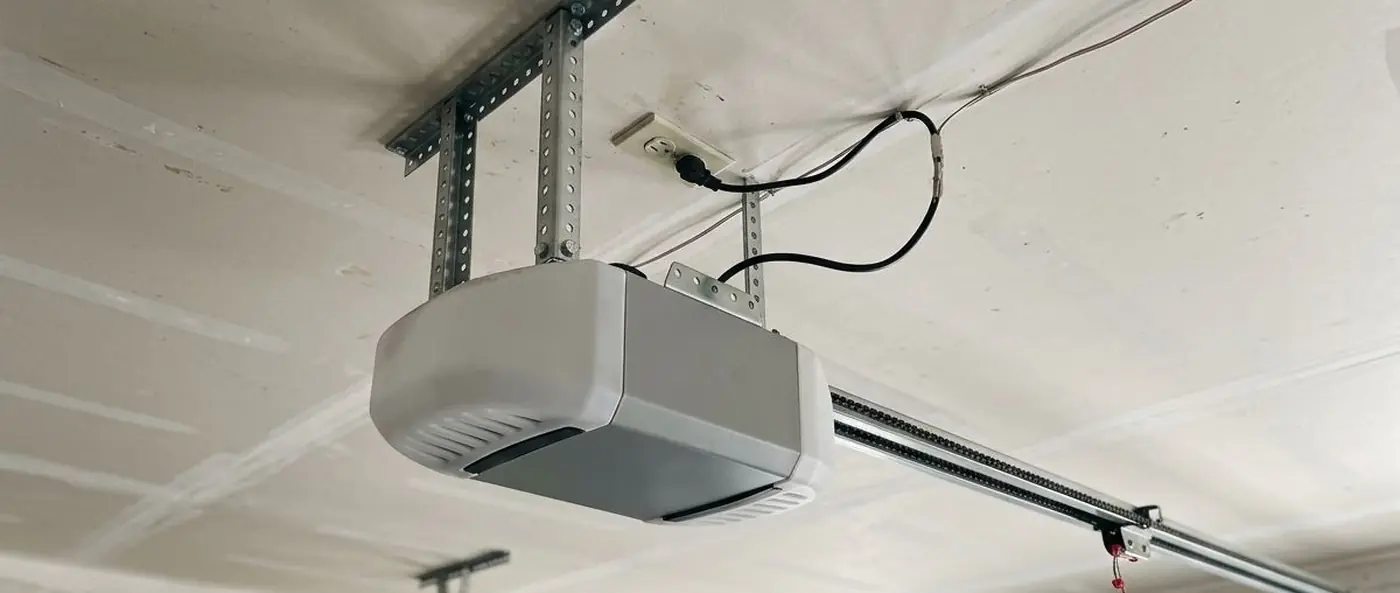
Pick what the door is doing to see the safe checks first, the point where you should stop, and the source behind each answer. The rule that never changes: leave springs, cables and bottom brackets to a trained technician, as DASMA TDS-151 advises.
The opener hums or runs, but the door does not move
Check the lock and the release first
First, from the floor, look at the spring above the door and the cables at each side. If the spring has a gap, a cable is loose or frayed, or the door hangs crooked, stop here: unplug the opener and treat it as a broken spring or cable.
Look for a manual lock bar or slide lock on the inside of the door. A locked door will not move.
See whether the red release cord was pulled. If the trolley is disconnected, the motor runs but the door stays put. Reconnect it only as your opener manual describes, with the door fully closed.
If the lock is open, the trolley is connected and it still will not move, the cause may be a spring, a stripped gear or the door itself. Ask for a repair visit.
The door starts down, then goes back up (or the light blinks)
Usually the safety sensors, which is the system doing its job
Clear anything in the doorway, including leaves, a broom or a garbage can near a sensor.
Wipe both small sensor lenses near the floor on each side of the door with a soft cloth.
Most sensors have a small light on each side. If one is off or flickering, the pair is likely out of line or a wire is loose.
Watch for low sun shining straight into a sensor at certain times of day, which can block the beam.
Never tape, bypass or remove the sensors. Federal rules require residential openers to reverse, and the sensors are part of how they protect people. If cleaning does not fix it, ask for an opener repair.
Make sure the opener is plugged in, and test the outlet with a lamp or phone charger.
Garage outlets are often on a GFCI that has tripped. Look for a reset button on a nearby outlet, and check the breaker panel.
In a power outage, the red release cord lets you lift the door by hand. Only pull it with the door fully closed, and only if the spring and cables look intact; a door with a broken spring can be too heavy to hold.
If power is fine and the opener is dead, ask for an opener repair. If the door feels very heavy when lifted by hand, the spring may also be broken.
Before you run it, look from the floor. If the door hangs crooked, a cable is loose or frayed, a roller is out of the track or a spring has a gap, do not run it. Unplug the opener and send the details.
If all of that looks normal, watch the door run from a few feet away. Note whether the noise comes from the rollers, the hinges, the opener rail or the springs.
Look for cracked or wobbling rollers and loose hinge bolts on the door sections.
Use only the lubricant your door or opener manual names. Do not grease the tracks themselves unless the manual says to.
Never loosen, adjust or remove springs, lift cables, bottom brackets or anything bolted to them. They hold the weight of the door under high tension. If a quick look does not explain the noise, ask for a tune-up or repair visit.
Check the spring and cables first, then the sensors
First, from the floor, look at the spring above the door and the cables at each side. If the spring has a gap, a cable is loose or frayed, or the door is crooked or out of its track, do not try to close it. Keep everyone clear and send the details.
If those look normal, the most common cause is a blocked or misaligned safety sensor. Clear the doorway and wipe both sensor lenses near the floor.
Check the wall control for a lock or vacation setting.
If it still will not close, look up your opener model in the maker’s manual before trying anything else. Do not tape, bypass or remove the sensors.
If a spring or cable looks damaged, leave the door open and keep clear. Start the details with URGENT and send them. If anyone is trapped or hurt, call 911.
A panel is dented or cracked, from a car or the wind
Check whether it still runs straight
First, look from the floor without running the door. If a section is bent near the hinges, a roller is out of the track, a cable is loose or the door hangs crooked, stop using it: unplug the opener, keep everyone clear and send the details.
If none of that shows, run it once while you watch from a few feet away. If it binds, scrapes or jerks, stop and leave it closed. Forcing it can damage the opener and the track.
If the door opens and closes smoothly, a dented section can usually wait for a planned repair.
Take photos of the outside and inside of the damaged section, and of any label on the door edge with the maker or model.
Send the photos. Many doors can take a single new section if the model is still made. If the door was bent, binds or left the track, treat it as a stop: do not run it until a technician has looked.
The one rule. Never loosen, adjust or remove springs, lift cables, bottom brackets or anything bolted to them. They hold the weight of the door under high tension.
Prevention
The two-minute monthly checks
DASMA TDS-364 recommends testing the reversing mechanism and the photo eyes every month.
01
Reversal
Lay a 2 x 4 flat under the door and close it. It should reverse on contact. DASMA TDS-369 describes the test.
02
Photo eyes
Pass an object through the beam while the door closes. It should stop and reverse.
03
Balance
With the opener released and the door closed, lift it partway. DASMA TDS-174 explains how a balanced door behaves.
Sources
Where the answers come from
Every answer links to a primary source. We read them on the date shown.
Applies to residential openers made on or after January 1, 1993; a closing door must start reversing within 2 seconds of contact, and photo eyes are an allowed secondary device.
Finding an opener model number, its manual and remote programming steps.
Accessed
Short answers
Troubleshooting questions, answered first
Short answers.
Why does my garage door go back up when closing?
Usually the photo eye sensors. They are blocked, dirty or out of line. They are part of the reversing protection required by 16 CFR 1211, so never bypass them.
Why does my opener hum but the door does not move?
Check the manual lock and the release cord first. If both are fine, the cause may be a broken spring or a stripped gear.
Is it safe to adjust the spring myself?
No.DASMA TDS-151 says these parts are under extreme tension and should be handled by a trained technician.
Send the details
Send it to get it fixed
Tell us what you saw. The troubleshooter can fill this in for you.
What happens next
1Send the detailsWhat the door is doing, your town, and a photo or two if you have them.
2We follow upYou hear back the way you asked, with next steps.
3Price in writingYou see it before any work starts, and the yes or no stays with you.
What helps us price it
A photo of the whole door from inside, and one of the problem
Door width and height, roughly (most are 8 or 16 ft wide)
The opener brand and model, from the label on the motor
Whether the door is single or double, steel or wood, insulated or not
Whether it is stuck open, stuck shut or still working
If anyone is trapped or hurt, call 911 first. Do not try to free a door by loosening springs or cables.